It seems that the Iranian elite has been caught similarly off-guard, and is still trying to read its own society to understand how broad is the societal discontent reflected in the mass protests.
This calculus is crucial - in some ways more so than whether the results are legitimate or, as some claim, electoral fraud.
It will determine whether the Iranian power elite - that is, the political-religious-military-security leadership who control the levers of state violence - moves towards negotiation and reconciliation between the increasingly distant sides, or moves to crush the mounting opposition with large-scale violence.
A lot depends on what the elite thinks is actually happening on the ground, and why the alleged fraud unfolded as it did.
Do the issues motivating the current protests ultimately derive from people's anger at perceived fraud and not having their votes counted? Or do they, as seems increasingly clear, reflect a much deeper level of anger at, and even opposition to, the nature and governing ideology and practises of the Iranian political system?
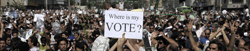

Equally important, if there was systematic fraud, was it perpetrated as a collective decision of a senior leadership unwilling to accept the cultural, political and economic liberalisation a Mousavi government would initiate, or, as University of Michigan professor Juan Cole and others have argued, did it owe to a sudden fit of pique by Supreme Leader Ayatollah Ali Khamenei?
His well-known personal antipathy to Mir Hossein Mousavi could have made the imminent prospect of his long-time political rival's victory so distasteful that he could not bring himself to sanction Mousavi's victory, leading to a hastily arranged fraud - many ballot boxes were allegedly never even opened before the official tabulation was announced - even as other parts of the leadership were laying the groundwork for a public announcement of Ahmadinejad's defeat.
What seems evident as the crisis deepens is that Ayatollah Khamenei, who most commentators have long assumed holds near absolute power in the country as Supreme Leader, is in a weaker position than previously believed. The collective religious and military leadership, along with the Revolutionary Guard, will likely have a lot of input into determining what course the government takes.
And it is certainly questionable whether these factions have shared core interests during this crisis, as the Revolutionary Guard - from whose ranks President Ahmadinejad emerged - is both culturally more conservative and economically more populist than much of the political and religious leadership.
The religious establishment is itself split into hard-line, moderate and more progressive factions, each of whose members are tied to factions within the economic, political and security elite, producing a complex and potentially volatile set of competing and contradictory loyalties and interests.
Ahmadinejad's and Khamenei's decisions in the coming days will be telling.
If the official tally was in fact broadly accurate, then they will likely be more willing to agree not just to a recount, but even to a run-off election, if that is what it takes to pacify the angry protesters.
Indeed, a second Ahmadinejad win would severely weaken reformist forces and increase the system's legitimacy.
Uncertain scenario
More generally, regardless of whether there was significant fraud the power elite could decide collectively that the protests are not motivated by broader concerns and thus do not threaten the stability of the system.
This could also lead them to agree to a broad recount or run-off, even at the risk of a Mousavi win, and it is worth mentioning here that Mousavi is no liberal; the "core values" of Khomenei's revolution - to which he advocates a return - are well within the mainstream of Iran's clerical culture.
Alternatively, if the protests do not lose steam in the coming days, the leadership could decide that the opposition is too broad and deeply rooted to attempt to crush it.
In this case, it would have little choice but to cave in to the protesters' demands or face losing its legitimacy in the eyes of the broader Iranian public, particularly if large numbers of protesters are arrested, injured or killed.
The greatest degree of uncertainty surrounds a scenario in which the power elite both concludes that the mass protests reflect deep-seated discontent by a large segment of the population, yet at the same time believes it has a narrow window of opportunity to deal with this situation forcibly before losing control to the rapidly encroaching street politics.
In this case, Iran could quickly approach a Tiananmen moment, in which the Iranian government calculates that crushing the pro-reform opposition will give it time to push the reformers back in the closet for the foreseeable future, and push the cosmopolitan liberal-cultural elite who have the ability to leave, to do so.
The problem is that Iran can't follow China's path.
It is true that if oil prices continue rising, they will produce enough revenue for the government to keep the poor and working classes happy, or at least quiescent.
But what allowed the Communist party in China to maintain its hegemony rather than merely dominance over Chinese society was its willingness to liberalise culturally at the same time as it closed down politically.
Cultural liberalisation became the safety valve that allowed the emerging generation of Chinese citizens to accept the continued power of the Communist party.
Needless to say, no such safety valve exists in the Islamic Republic, where a cultural perestroika is precisely what Ahmadinejad and his supporters in the leadership and among the people want to prevent.
Collapsing bargain
In China the government struck a bargain with the people, telling them: "You can do whatever you want as long as you don't challenge the power of the state."
The Iranian government has over the last two decades negotiated a very different and more narrow bargain with its citizens: "You can do what you want behind closed doors, as long as you keep the music down. But we own the street and the public sphere. So put your headscarf on before you leave the house, and don't think about challenging cultural or political limits publicly."
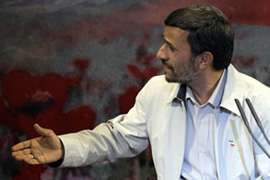 |
| If Ahmadinejad's win is reconfirmed, it could severely weaken reformist forces [AFP] |
That bargain has now collapsed as hundreds of thousands of Iranians have, at least for the moment, reclaimed the streets.
If Ahmadinejad has been railing against "velvet revolutionaries" since he took office, he is today counting on the situation in Iran resembling the Czechoslovakia of 1968 rather than 1989.
Yet with one of the world's youngest populations and an increasingly urban, educated and sophisticated citizenry, it is hard to know how long the Iranian government can continue to impose its conservative moral values upon a bourgeois-aspiring, culturally open technocratic class whose expertise and loyalty will be crucial for Iran's long-term social, economic and political development.
Saudi Arabia is a good example of what happens when you force a culture shut for too long.
There is a third way to interpret the rapidly unfolding protests. Here Ahmadinejad and the current political and religious leadership on the one side, and Mousavi and the reformers on the other, are merely rallying poles around which two bitterly opposed histories of, and visions for, post-revolutionary Iran have rallied and are now engaged in a battle that was long in coming.
Maybe, as one protester exclaimed, "There's no one in charge right now", either among the still nascent protest movement or the state that is trying to figure out how to suppress it without losing a large chunk of its legitimacy among the millions of Iranians who are likely still on the fence over whose election narrative to believe.
Pent-up forces
Indeed, this election might well have released a host of pent-up forces - desperate hope for change, smouldering resentment at the vast inequalities plaguing Iran, utter disdain for the other side's core cultural identity - that will necessitate a bloody if cathartic settling of scores between two irreconcilable sides over grievances that date back to the dawn of the revolution, and its innumerable betrayals, failures and still unrealised goals.
This is not to say that the Islamic Republic could be replaced by a more secularly-defined republic any time soon.
The thundering chants of "Allahu Akbar" at opposition rallies remind us that Islam, even Islamism - that is, political Islam - and democracy can, and should, go together.
But Iran today is a very different place than during the early days of the revolution.
Iran long ago lost the singular, collective will that enabled the revolution; the protesters are no longer imbued with the idea of bi-kodi, or self-annihilation, martyrdom and complete self-sacrifice that toppled the Shah and helped the country withstand eight years of brutal war with Iraq.
The majority of Iranians, particularly young people, even, one can imagine, the poorer and less educated ones overly represented among the Revolutionary Guard would prefer to focus on its counterpart, khod-sazi, or self-construction, as the better attitude with which to build their society today.
If the protest movement that has flooded the streets in the last few days can forge a positive and inclusive vision for Iran's future, one that addresses the many social, ethnic, economic and cultural issues underlying the current protest holistically, they could very well change the face of the Islamic Republic, if not now, then in four years' time.
Mark LeVine is professor of modern Middle Eastern history at the University of California Irvine and is the author of Heavy Metal Islam: Rock, Resistance, and the Struggle for the Soul of Islam and Impossible Peace: Israel/Palestine Since 1989.
The views expressed in this article are the author's own and do not necessarily reflect Al Jazeera policy.
| Source: | Al Jazeera |